Table of Contents
Rebuilding identity after addiction means replacing the organizing role substance use played in your life with new sources of purpose, routine, and contribution. It takes longer than detox and matters more than most people expect.
I’m Nick, co-founder and co-owner of Hollywood Hills Recovery, and I reached that point roughly four years into sobriety.
Today I actually know who I am. My real identity is being clean and sober.
I’ll explain what the identity gap actually is, what the research says about how people close it, and why service to others shows up in the data as one of the strongest predictors of sustained recovery.

Why Does Sobriety Create an Identity Problem?
Active addiction organizes a person’s entire day, social circle, and self-concept around one activity. Removing it leaves a structural vacancy, not just an absence of a substance.
People in early recovery commonly report not knowing how to answer basic questions about themselves: what they enjoy, who their friends are, what they want. The substance had been answering those questions by default.
The Wreckage Problem
I know the hardest part firsthand.
I created so much wreckage in my past. I hurt so many people and did so many things that the weight of it felt unbearable. Today, I have learned from those mistakes.
The identity gap is not only about what is missing going forward. It is about what to do with everything already done. Shame keeps people anchored to the version of themselves they are trying to leave, and shame is a documented relapse driver.
What Do the Numbers Say About Life After Addiction?
Recovery is far more common than the cultural narrative suggests, and the population of people who have rebuilt is enormous.
Every figure below comes from the National Recovery Study, led by John Kelly of Harvard Medical School and the Recovery Research Institute, unless otherwise noted.
- 22.3 million American adults, approximately 9% of the adult population, have resolved a significant alcohol or drug problem.
- In the year the study was conducted, more Americans reported having resolved a substance problem than currently had an active substance use disorder.
- Roughly half of those who resolved a problem did so with some form of professional or informal assistance and half did so without any.
- Only 40% of people who resolved a substance problem had ever received formal treatment for it.
- Only about 46% of people who resolved a problem describe themselves as being “in recovery.” More than half never adopt the label.

The Part That Does Not Get Said
According to the same National Recovery Study, people who resolved a substance use problem are worse off than the general population on measures of health and employment. Recovery is common, and rebuilding the material conditions of a life takes years of work after the substance is gone.
That gap between resolving the addiction and rebuilding the life is exactly where identity work lives.
Does Helping Others Actually Help Your Own Recovery?
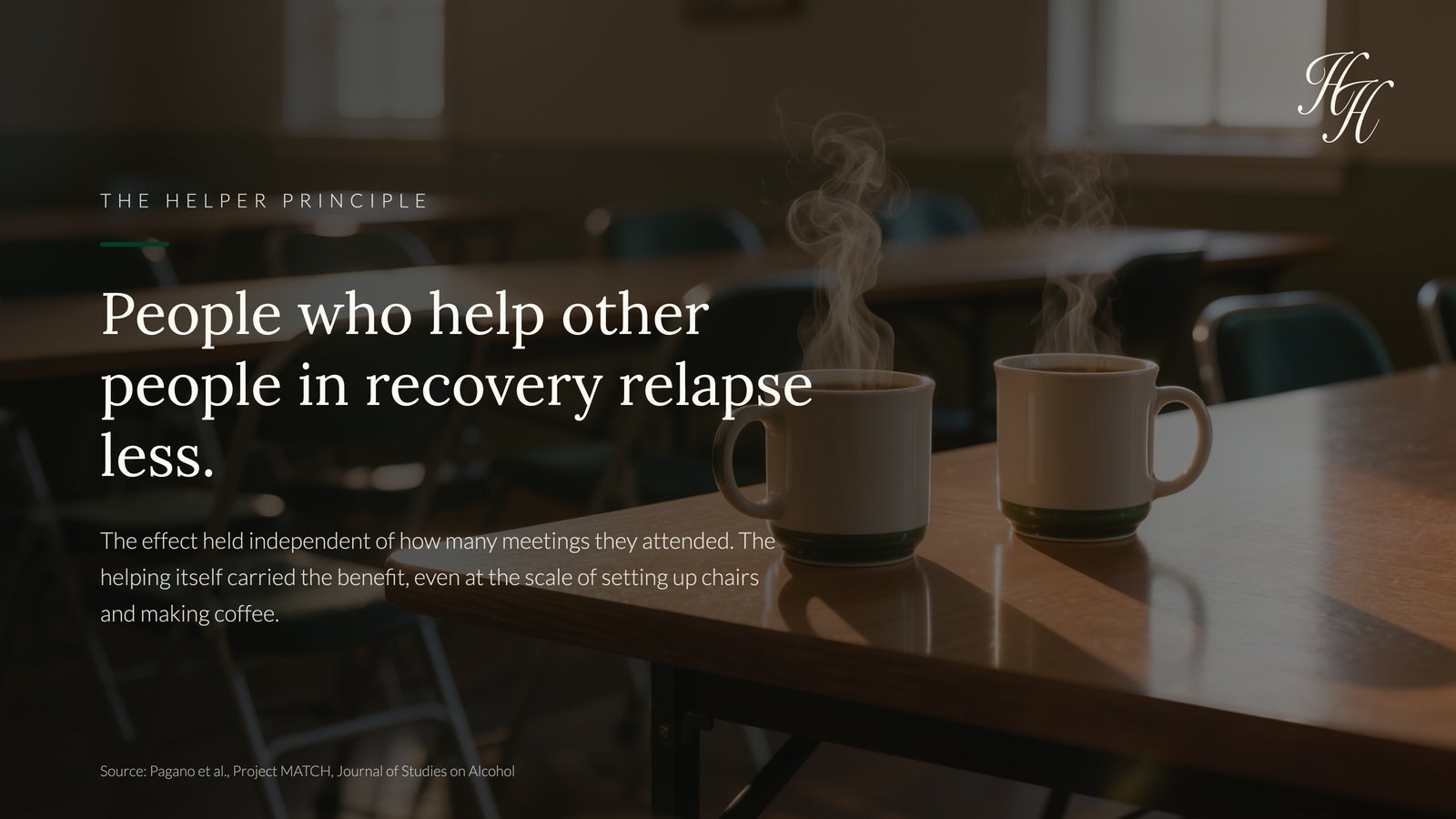
People in recovery who help other people in recovery are significantly less likely to relapse, according to one of the largest addiction outcome studies ever conducted.
According to Maria Pagano and colleagues, writing in the Journal of Studies on Alcohol in 2004, taking on helping roles predicted lower relapse. Their analysis drew on Project MATCH, a National Institute on Alcohol Abuse and Alcoholism trial with 1,726 participants. She compared people who took on helping roles in AA, such as becoming a sponsor or completing the twelfth step, against those who did not.
The Helper Therapy Findings
- Participants who helped other alcoholics were significantly less likely to relapse in the year following treatment.
- That effect held independent of how many AA meetings a participant attended, meaning the helping itself carried the benefit.
- The only demographic difference between helpers and non-helpers was age, with helpers averaging 3 years older.
- According to separate research by Pagano, participants with high social estrangement at intake were significantly less likely to relapse or reoffend if they had engaged in service within AA.
- Service counted even at the smallest scale, including setting up chairs, greeting newcomers, and making coffee.
Why Service Works on Identity Specifically
Helping someone else forces a role change. You stop being the person who receives help and become the person who provides it. That is an identity claim you can act on daily, and it is available from the first week of recovery.
What Does the Peer Support Research Show?
Peer support consistently improves substance use outcomes across the literature.
- Peer recovery support is associated with reduced relapse rates, better relationships with providers, higher treatment retention, and greater treatment satisfaction (Sharon Reif and colleagues in Psychiatric Services).
- Peer support is linked to reduced substance use, better treatment adherence, faster entry into treatment after referral, and lower rates of inpatient readmission (Eddie and colleagues in Frontiers in Psychology).
- Mutual-help groups are the most common form of assistance used by people who resolved an alcohol or drug problem, ahead of outpatient treatment (National Recovery Study).
- Studies reviewed point to social support and sustained connection as central mechanisms behind these results (Recovery Research Institute).
How Do You Rebuild an Identity in Practice?
Identity reconstruction happens through action rather than insight, and 6 categories of action do most of the work:
- Taking on service roles, starting with the smallest available commitment.
- Rebuilding or replacing a social network so that connection is not tied to use.
- Returning to work or education, which restores an external role and daily structure.
- Repairing relationships through consistent behavior over time, not through single conversations.
- Developing interests that predate or are unrelated to the substance.
- Naming and treating the shame directly in clinical work rather than waiting for it to fade.
My Version
I kept my job moving freight, and trucking is my actual career. Hollywood Hills Recovery is something else.
This is not a career for me; it is a passion. What I really want to do with my life is give back to the community.
That distinction matters to me. I did not replace my identity exclusively with recovery work. I built a life with a job, a purpose, and a community, and recovery work occupies the purpose slot rather than all three.
Where Clinical Treatment Fits Into Identity Work
Identity work starts inside treatment, not after it. Our residential intensive treatment program builds in group work, therapy, and community precisely because isolation is what makes the identity gap unbearable.
Before that, medically supervised detox clears the physical dependence so the psychological work becomes possible.
Treating the Shame Underneath
Shame, depression, and unprocessed trauma are what make the wreckage of the past feel permanent. Our dual diagnosis program treats those conditions alongside the substance use disorder rather than after it.
We also offer neurofeedback therapy for clients working on emotional regulation in early recovery.
Where Community Continues
The peer relationships that sustain a new identity are formed in treatment and maintained afterward. Our aftercare program connects alumni to ongoing counseling, 12-step engagement, and alumni events specifically so the network does not dissolve at discharge.
Rebuilding Around a Career
For people whose professional identity is central and whose recovery has to fit around it, our executive treatment program is designed for exactly that constraint.
Families Rebuild Too
The person in recovery is not the only one whose role changes. Families often need their own framework, which we covered in what is Al-Anon and how does it support families of addicts.
My Answer to the Question
My answer to who I am without drugs took four years and a lot of unglamorous daily work to reach. When I give that answer now, I frame it around what I want for other people.
It has been remarkable to experience the happiness and joy that recovery has instilled in me, and I want to see that in everyone else going through this process.
That is the helper therapy principle in plain language. I lived it before I ever knew there was research describing it.