Life after rehab determines whether treatment holds. Discharge, not admission, is the point at which outcomes diverge, and the research measuring what follows is consistent across four decades of study. An average of 30.4% of patients drop out of substance use treatment before completing it [1]. Federal guidance holds that participation under 90 days is of limited effectiveness [2]. Among US adults who have resolved an alcohol or drug problem, only 20.3% have been continuously abstinent since resolving it [3].The clearest counterexample comes from a population that never leaves structure. Among 904 physicians monitored for five years after treatment, 78.7% were licensed and working at follow-up, and 81% never tested positive across the entire period [4]. What separates that cohort from the general treated population is not diagnosis, severity, or motivation. It is how long the support lasts after discharge.
Our incredible intake team is ready to answer all your questions and guide you through the process.
Section 1: Why Is Discharge the Highest-Risk Moment in Treatment?
Discharge is the highest-risk moment because support ends before the clinical dose is complete. A meta-analysis of 151 studies covering 26,243 participants found an average dropout rate of 30.4% across in-person psychosocial substance use disorder treatments [1].
The 90-Day Threshold
The National Institute on Drug Abuse states that participation of less than 90 days is of limited effectiveness, and that treatment lasting significantly longer is recommended for maintaining positive outcomes [2]. The dose data and the retention data conflict directly. The point at which outcomes measurably improve is the same point at which a large share of patients have already left.
Completion Rates Vary by Level of Care
Federal treatment admissions data shows completion diverging sharply by setting, at roughly 65% for specialized residential treatment and between 48% and 52% for outpatient treatment [5]. Level of care, not diagnosis, predicts whether an episode finishes.
Section 2: What Do Relapse Rates Actually Measure?
Relapse rates measure symptom recurrence in a chronic condition, not treatment failure. Between 40% and 60% of people treated for substance use disorders return to use, a range comparable to symptom recurrence in type 2 diabetes, hypertension, and asthma [6].
Does Severity at Admission Predict Outcomes?
Crisis severity at admission does not predict what happens after discharge. Federal survey data found that not being ready to stop using was the most common reason adults gave for not entering treatment, cited by 40.7% [7], and only 5.5% of untreated adults with a substance use disorder report any perceived need for care [8]. Those figures explain why entry is delayed. They say nothing about durability, because every variable that separates strong outcomes from poor ones is measured after admission rather than before it. Whether a person had to hit rock bottom to get sober describes when treatment began, not whether it held.
Section 3: What Does Success Look Like After Discharge?
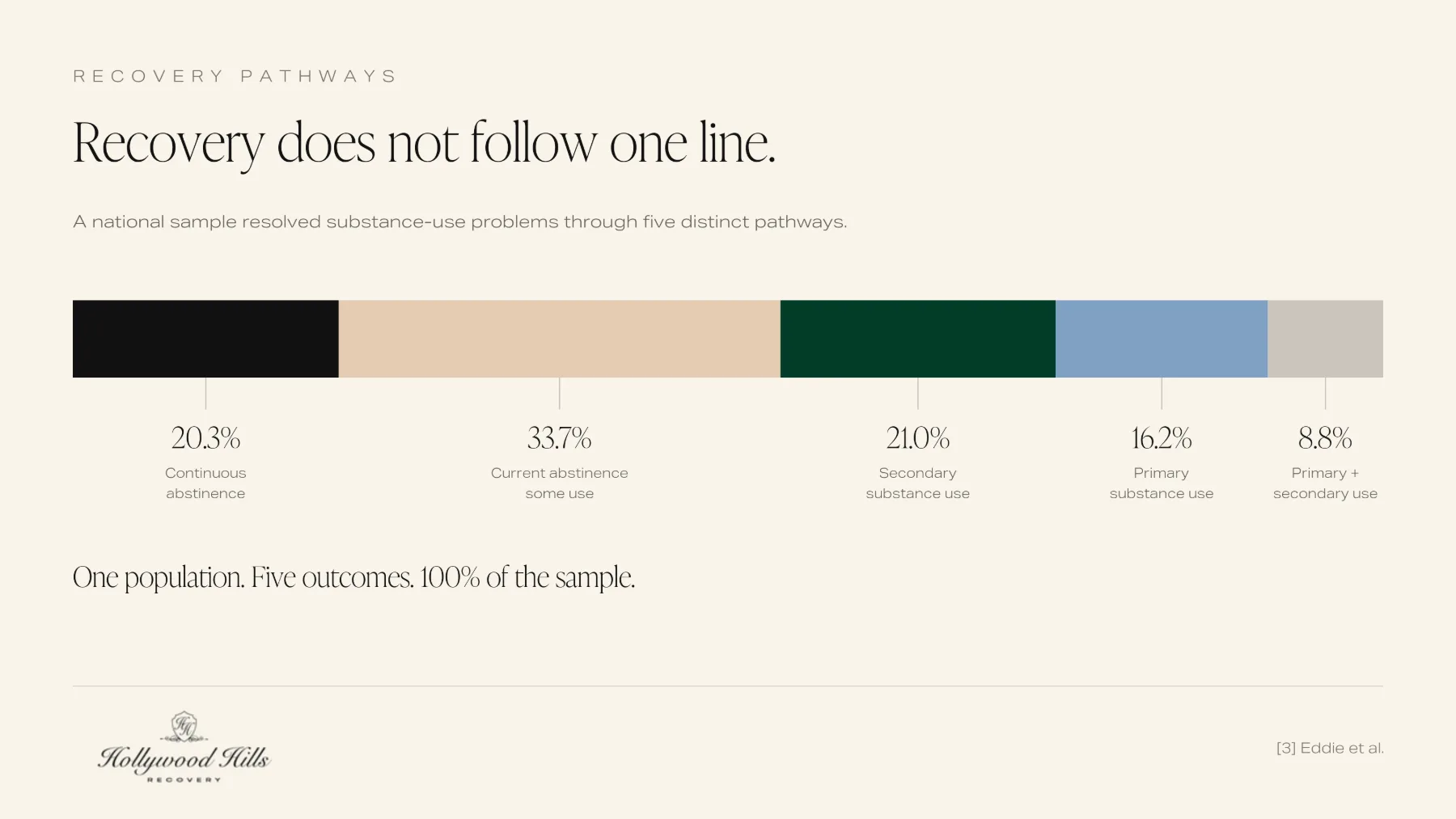
Continuous abstinence is the minority outcome among people who resolve a substance problem. In a nationally representative sample of 2,002 US adults who reported resolving an alcohol or drug problem, 20.3% had been abstinent since resolution [3].
The Full Distribution of Recovery Pathways
The remaining pathways divide as follows [3]:
33.7% are currently abstinent but report some substance use since resolving the problem
21.0% are using a secondary substance
16.2% are using their primary substance
8.8% are using both their primary and a secondary substance
Resolution Is Common and Undercounted
Recovery reaches a far larger population than treatment statistics capture. A national probability survey estimated that 9.1% of US adults, or 22.35 million people, have resolved a significant alcohol or drug problem, and that 53.9% used an assisted pathway involving treatment, medication, or mutual-help groups [9].
Section 4: What Do Five-Year Monitoring Outcomes Prove?
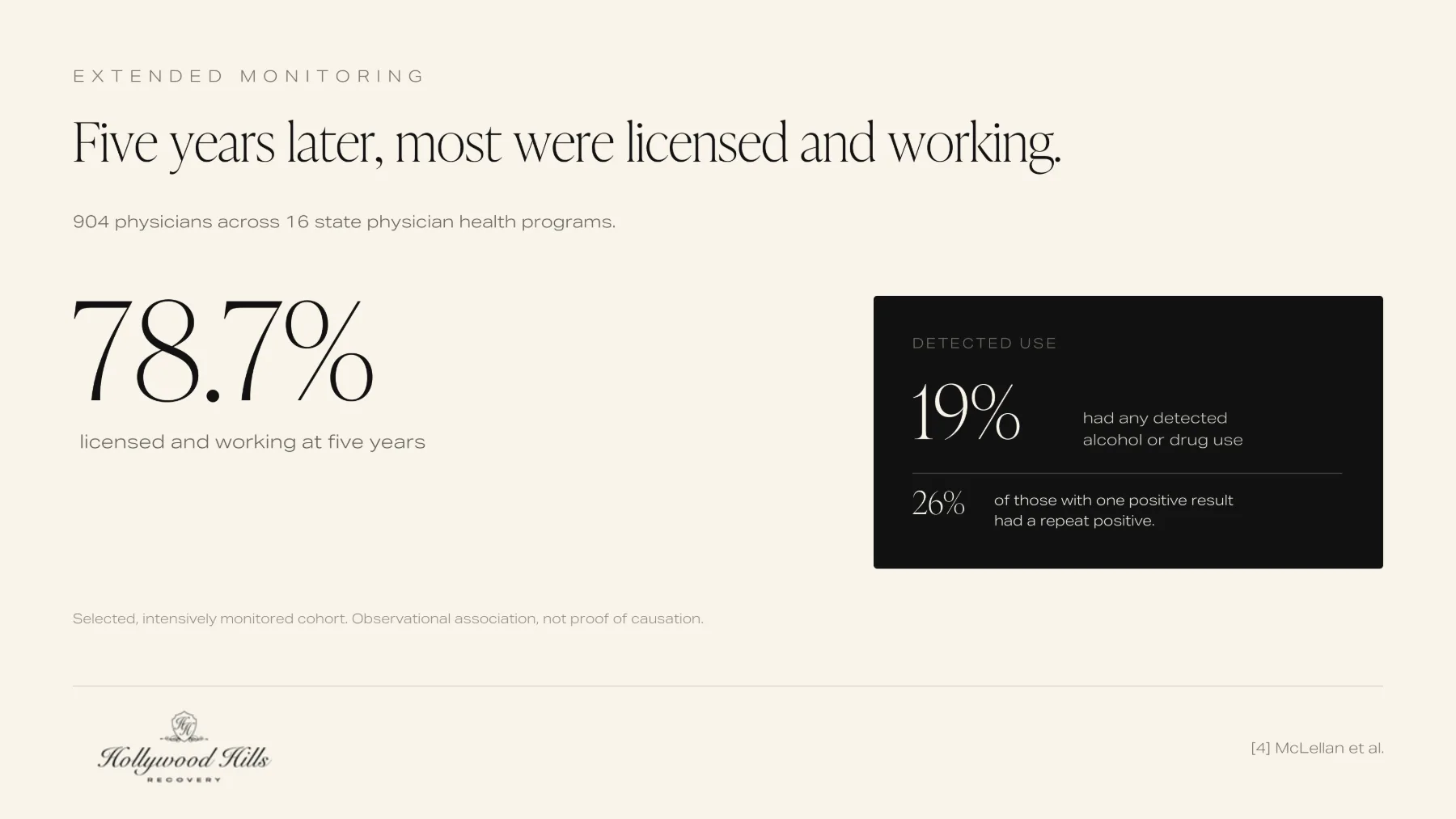
Extended monitoring produces materially different outcomes. A five-year cohort study of 904 physicians consecutively admitted to 16 state physician health programs found that 78.7% were licensed and working at five-year follow-up [4].
The Numbers Behind the Headline
Within that cohort [4]:
80.7% of physicians with known outcomes completed treatment and resumed practice under supervision
19% had alcohol or drug use detected by urine testing at any point across the full five years
26% of those with one positive test result had a repeat positive result
What the Cohort Holds Constant
The cohort is useful because of what it holds constant, not because of who its participants are. Physicians entered with the same diagnoses and comparable severity to the general treated population, and the variable that differs is monitoring duration: five years of scheduled check-ins, random testing, and case management rather than a single episode of care. What fills those five years is the ordinary repeatable day that structure in early recovery is built from.
Section 5: How Providers Are Rebuilding the Post-Discharge Window
Providers are extending the care horizon past discharge. The specification-level shift is to treat the transition out of residential care as the center of the treatment plan rather than its endpoint.
The Four Components of Continuity
Aftercare that is planned and started before discharge rather than handed over at the door
Simultaneous treatment of co-occurring conditions through dual diagnosis tracks rather than sequential referral
Written, individualized planning, documented in a relapse prevention plan
Stable housing through the first year, which raises the practical question of who pays for sober living after rehab
Medically supervised detox and residential inpatient treatment remain the entry point, but the monitoring evidence indicates that the months following them carry more weight in the outcome than their own duration does.
Access Remains the Prior Constraint
Post-discharge care only reaches people who enter treatment at all. Of the 47.2 million people aged 12 or older who needed substance use treatment in 2025, 16.0% received it [10], and FDA-approved medications reached 2.6% of people with alcohol use disorder and 15.7% of people with opioid use disorder [11]. That shortfall is examined at the state level in California addiction treatment utilization and gaps.
Section 6: What the Next Five Years Require
Closing the post-discharge gap requires measuring years rather than episodes. Three shifts follow from the evidence:
Report outcomes at five years, the interval at which physician health program results become interpretable [4].
Define success beyond continuous abstinence, which describes 20.3% of people who resolve a substance problem [3].
Fund the post-discharge window at the level currently reserved for the treatment episode itself, given that overdose mortality has declined for a third consecutive year while treatment receipt has fallen [12].
Conclusion
Addiction treatment research has largely measured the wrong interval. The episode is short, well studied, and completed by most of the people who reach it. The years after discharge are long, sparsely funded, and where the outcome is actually decided. The physician monitoring data is the clearest available evidence that when structure lasts, so does recovery.
Works Cited
[1] Lappan SN, Brown AW, Hendricks PS. "Dropout Rates of In-Person Psychosocial Substance Use Disorder Treatments: A Systematic Review and Meta-Analysis." Addiction. 2020;115(2):201-217.
https://pubmed.ncbi.nlm.nih.gov/31454123/
Cited for the 30.4% average dropout rate across 151 studies and 26,243 participants.
[2] National Institute on Drug Abuse. "Principles of Drug Addiction Treatment: A Research-Based Guide."
Cited for the finding that participation of less than 90 days is of limited effectiveness.
[3] Eddie D, Bergman BG, Hoffman LA, Kelly JF. "Abstinence Versus Moderation Recovery Pathways Following Resolution of a Substance Use Problem." Alcoholism: Clinical and Experimental Research. 2022;46(2):312-325.
https://pubmed.ncbi.nlm.nih.gov/34931320/
Cited for the recovery pathway distribution among 2,002 US adults, including 20.3% continuously abstinent since resolution.
[4] McLellan AT, Skipper GS, Campbell M, DuPont RL. "Five Year Outcomes in a Cohort Study of Physicians Treated for Substance Use Disorders in the United States." BMJ. 2008;337:a2038.
Cited for 904 physicians across 16 state programs, 78.7% licensed and working at five years, 80.7% completion, 19% detection, and 26% repeat positives.
[5] Stahler GJ, Mennis J, DuCette JP. "Residential and Outpatient Treatment Completion for Substance Use Disorders in the U.S." Addictive Behaviors. 2016. Based on SAMHSA Treatment Episode Data Set.
https://pubmed.ncbi.nlm.nih.gov/26882312/
Cited for completion rates of roughly 65% in residential treatment and 48% to 52% in outpatient treatment.
[6] McLellan AT, Lewis DC, O’Brien CP, Kleber HD. "Drug Dependence, a Chronic Medical Illness: Implications for Treatment, Insurance, and Outcomes Evaluation." JAMA. 2000;284(13):1689-1695.
https://pubmed.ncbi.nlm.nih.gov/11015800/
Cited for the 40% to 60% relapse range and the comparison to type 2 diabetes, hypertension, and asthma.
[7] Substance Abuse and Mental Health Services Administration. "Receipt of Services for Substance Use and Mental Health Issues Among Adults: Results from the 2015 National Survey on Drug Use and Health."
Cited for the 5.5% perceived-need figure among untreated adults with a substance use disorder.
[9] Kelly JF, Bergman B, Hoeppner BB, Vilsaint C, White WL. "Prevalence and Pathways of Recovery from Drug and Alcohol Problems in the United States Population." Drug and Alcohol Dependence. 2017;181:162-169.
https://pubmed.ncbi.nlm.nih.gov/29055821/
Cited for 9.1% of US adults (22.35 million) having resolved a significant problem and 53.9% using an assisted pathway.
[10] Substance Abuse and Mental Health Services Administration. "SAMHSA Releases Annual National Survey on Drug Use and Health." July 27, 2026.
Cited for 47.2 million people needing substance use treatment in 2025 and 16.0% receiving it.
[11] Substance Abuse and Mental Health Services Administration. "Release of the 2025 National Survey on Drug Use and Health." SAMHSA Blog. July 27, 2026.
Cited for 69,147 predicted overdose deaths for the 12 months ending January 2026 and the 13.2% year-over-year decline.
[13] Centers for Disease Control and Prevention, National Center for Health Statistics. "U.S. Overdose Deaths Decrease for Third Consecutive Year in 2025." May 13, 2026.
“The reason for our success is no secret. It’s our simple commitment to fully understanding your struggle and to provide you the most comprehensive, guilt-free treatment you deserve.”
We work with most major insurance carriers. To find out your coverage options, fill out the form below and one of our admissions representatives will contact you as soon as possible.
Thank you for reaching out! One of our representatives will be in touch with you shortly.
Oops! Something went wrong while submitting the form.