Table of Contents
Some people with mild alcohol use disorder can learn to drink moderately. People with severe alcohol use disorder generally cannot, and no clinical tool reliably predicts in advance which category a given person falls into.
I’m Nick, co-founder and co-owner of Hollywood Hills Recovery, and I answered the question for myself in 2018.
I didn’t know how to have one drink. I didn’t know how to simply have fun in moderation. I went to those extreme measures, just like so many other people do.
I’ll cover what the research actually shows about moderation as a treatment goal, who it works for, and why the prediction problem makes it a risky bet for anyone with a severe history.

Why I Stopped Trying to Moderate
My realization was not that moderation is wrong in principle. It was that it had never once worked for me.
I had gone to extreme measures repeatedly, and eventually I reached a specific conclusion about my identity: being clean and sober is my real identity, not a restriction placed on top of it. That reframing is the difference between white-knuckling abstinence and choosing it.
The Repeated Attempt Is the Data
Most people who eventually pursue abstinence did not skip the moderation experiment. They ran it, often for years, and collected their own evidence. If you have set drinking limits and broken them more than a handful of times, you already have a personal dataset. It is worth taking seriously.
What Does Alcohol Use Disorder Severity Actually Mean?
According to the National Institute on Alcohol Abuse and Alcoholism, alcohol use disorder is diagnosed on an 11-criteria scale drawn from the DSM-5, and severity determines which treatment goals are realistic.
- Mild: 2 to 3 criteria met.
- Moderate: 4 to 5 criteria met.
- Severe: 6 or more criteria met.
Severe alcohol use disorder typically involves physical dependence, withdrawal symptoms, loss of control over quantity, and serious life consequences. Abstinence is the standard clinical recommendation at that level.

The Criteria Worth Checking Yourself Against
- Drinking more, or longer, than intended.
- Wanting to cut down and being unable to.
- Spending significant time drinking or recovering from drinking.
- Cravings and strong urges to drink.
- Drinking interfering with work, school, or home responsibilities.
- Continuing despite relationship problems caused by drinking.
- Giving up activities that used to matter.
- Drinking in situations that increase risk of harm.
- Continuing despite a physical or psychological problem caused by alcohol.
- Needing more alcohol for the same effect, which is tolerance.
- Withdrawal symptoms when the effect wears off.
What Does the Research Say About Moderation Versus Abstinence?
Most people who enter treatment intending to moderate end up choosing abstinence instead, and the shift happens fast.
According to the VetChange trial, a web-based alcohol intervention published by Enggasser and colleagues in 2015, 305 veterans selected their own drinking goal and were allowed to change it weekly. The migration went in one direction.
What Happened When People Chose Their Own Goal
- At the start, 86.9% of participants chose moderation and 13.1% chose abstinence.
- By the end, 68.6% held a moderation goal and 31.4% held an abstinence goal.
- The share choosing abstinence more than doubled over the course of the intervention.
- Roughly 20% of participants from each starting group switched goals at some point.
- Participants who initially chose moderation reported significantly more heavy drinking days at baseline than those who chose abstinence.
That last point is the one worth sitting with. According to the VetChange researchers, the people drinking most heavily were the most likely to pick moderation as their goal. Severity did not make people more cautious. It made them more optimistic.
What the Study Does Not Say
Honest reporting requires stating the limits. According to the same trial, participants reduced their drinking and alcohol-related problems significantly regardless of which goal they chose, and baseline severity did not predict different outcomes across goal patterns.
In other words, moderation goals are not useless. For a population of veterans with risky drinking, both goals produced improvement. The study does not license a claim that abstinence beats moderation for everyone.
What it does show is that when people are free to revise their goal in light of their own results, a substantial share move toward abstinence rather than away from it.
Severity Still Shapes the Recommendation
According to the National Institute on Alcohol Abuse and Alcoholism, alcohol use disorder ranges from mild to severe, and lasting changes in the brain caused by alcohol misuse leave people vulnerable to relapse. Treatment recommendations follow that severity gradient, which is why abstinence is the standard clinical goal at the severe end of the scale.
Who Is Moderation Realistically an Option For?
Moderation is a defensible goal under 5 conditions:
- Mild to moderate alcohol use disorder, without severe dependence.
- No history of serious withdrawal symptoms on stopping.
- Periodic problems rather than daily physical dependence.
- No significant alcohol-related health complications.
- Willingness to commit to structured limits, tracking, and professional monitoring.

If withdrawal has ever been part of your experience, moderation is not the right target. According to the National Institute on Alcohol Abuse and Alcoholism, seizures and delirium tremens are potential withdrawal complications, making alcohol one of the few withdrawal syndromes that can be fatal without medically supervised detox.
Why Family History Changes the Calculation
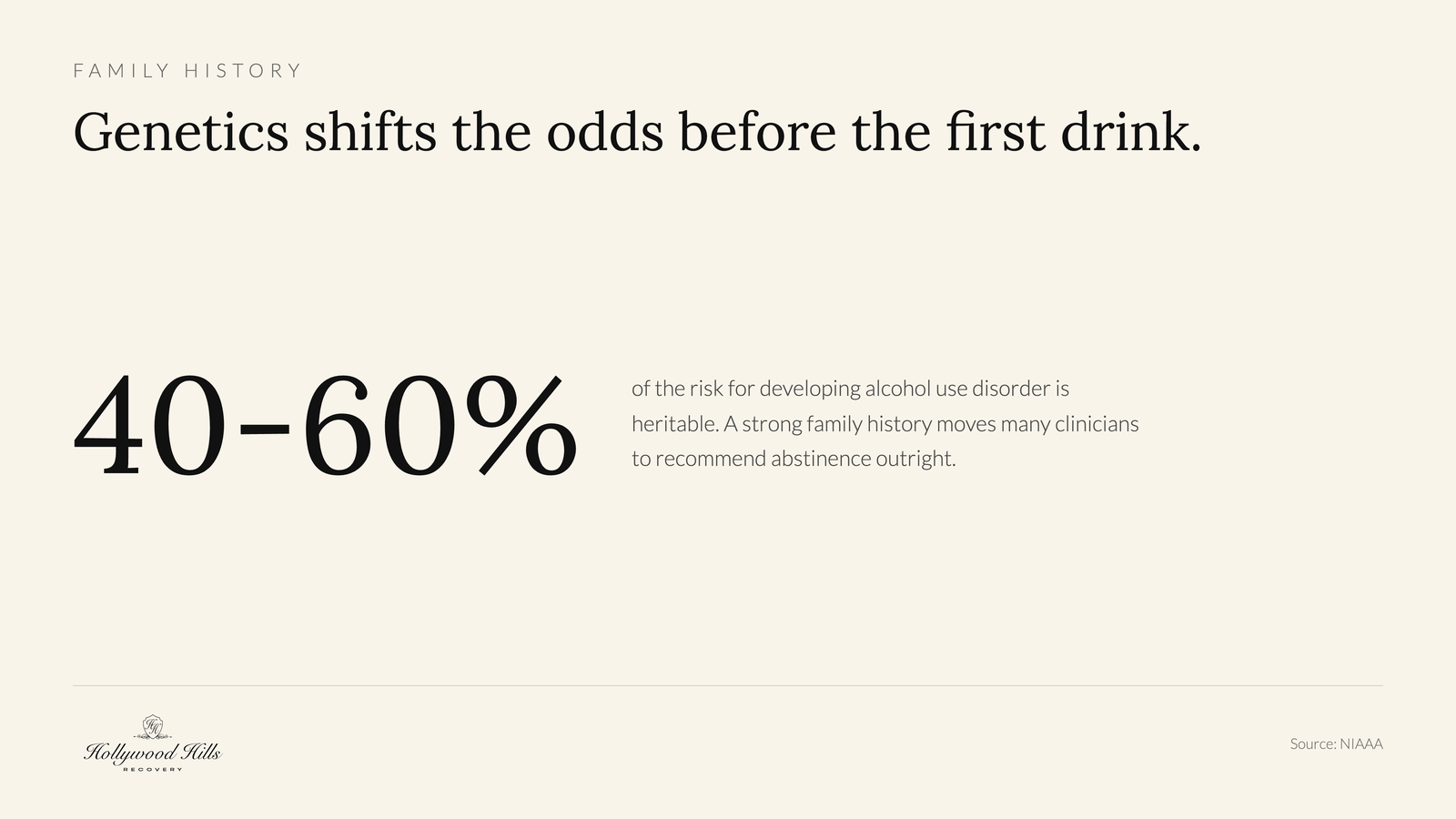
According to the National Institute on Alcohol Abuse and Alcoholism, between 40% and 60% of the risk for developing alcohol use disorder is heritable. A strong family history does not guarantee that moderation will fail, but it shifts the odds enough that many clinicians recommend abstinence outright.
Why Cross-Substitution Undermines Moderation Plans
Moderation plans that target alcohol alone frequently fail because the underlying pattern relocates. Someone who successfully limits drinking may increase cannabis use, benzodiazepine use, or prescription stimulant use instead.
This is why abstinence is generally advised for anyone with a history involving multiple substances. If your history includes benzodiazepines or prescription stimulants alongside alcohol, a single-substance moderation plan is unlikely to hold.
The Trigger Effect
According to the National Institute on Alcohol Abuse and Alcoholism, even small amounts of alcohol can act as a trigger, reactivating cravings in people with a history of dependence. That is the mechanism behind my experience of never being able to stop at one.
What Treatment Looks Like When Abstinence Is the Goal
Treatment for alcohol addiction starts with stabilization and moves into the clinical work of understanding what the drinking was doing for you.
Our residential intensive treatment program provides the therapeutic depth that outpatient moderation coaching cannot, particularly for people who have already attempted moderation and watched it fail.
Treating What Sits Underneath the Drinking
Alcohol use disorder co-occurs with depression, anxiety, and trauma at high rates, and moderation attempts almost always fail when the underlying condition goes untreated. Our dual diagnosis program addresses both simultaneously.
For treatment-resistant depression that persists into sobriety, we also offer TMS treatment.
Protecting Sobriety After Discharge
Abstinence holds when it is supported. Our aftercare program connects clients to continued counseling, 12-step engagement, and sober living resources. Housing costs come up quickly, and we broke them down in who pays for sober living after rehab.
Gender-Specific Programming
Drinking patterns, social pressure, and relapse triggers differ meaningfully by gender, which is why we run separate men’s and women’s treatment tracks.
The Honest Framing
The question is not whether moderation is possible for anyone. It is whether it is a reasonable bet for you specifically, given a prediction problem that clinical science has not solved.
I answered it by looking at my own history rather than at the research. I could not have one drink, and once I stopped negotiating with that fact, I built a life around it. I have held that line since July 20, 2018.